C
Guitar Chord Chart
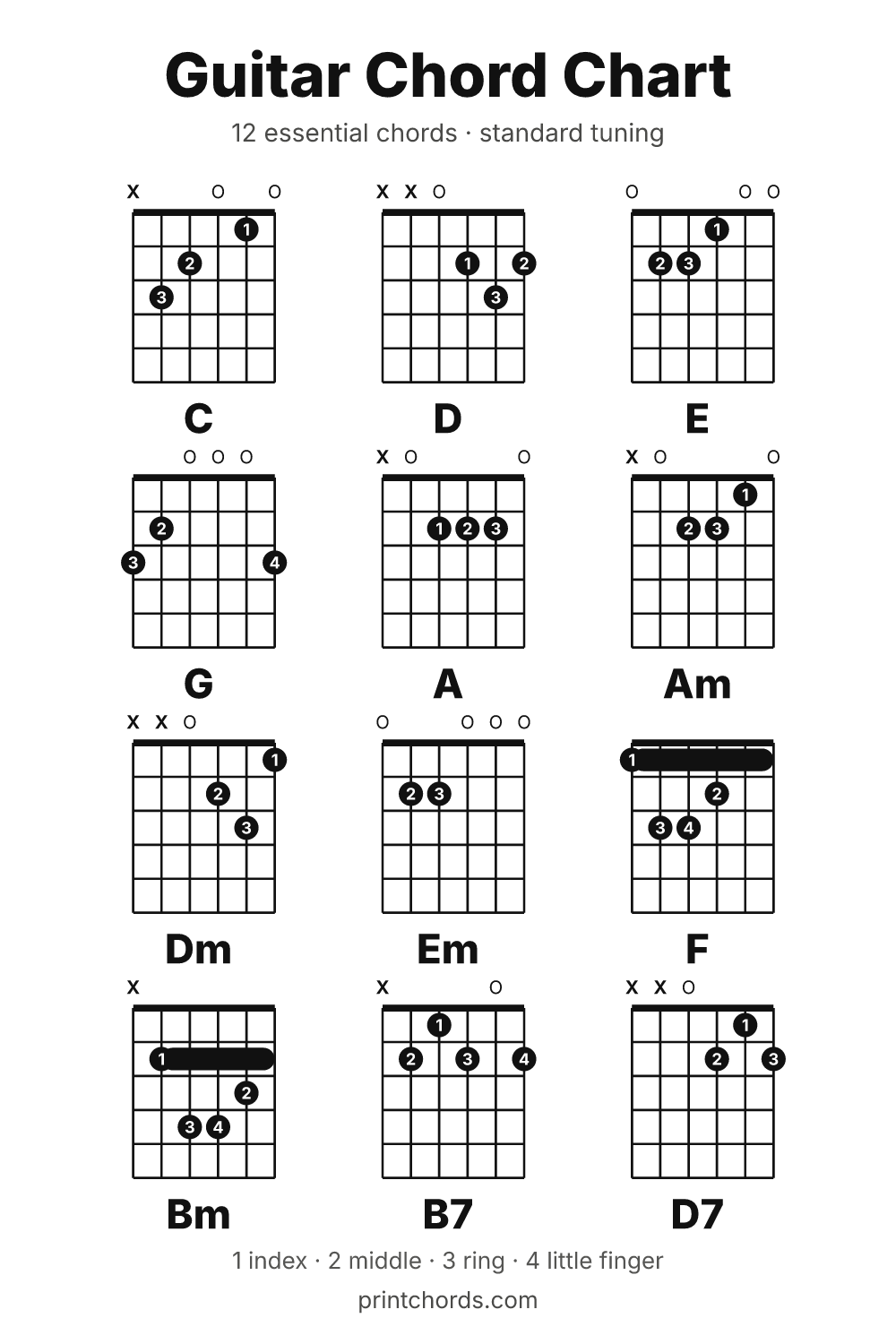
12 essential guitar chords. Print the full chart or save it for later.
Printable version
How to use this chart
These twelve chords cover most of what a beginner songbook asks for. Eight are open shapes that use the fretting hand lightly; The other four, F, Bm, B7 and D7, turn up as soon as a song leaves the easiest keys.
A sensible order is Em, A and D first, because they share fingers and frets, then C and G, then Am and Dm. Leave F and Bm until the open shapes are automatic: they are barre chords and they need hand strength that comes from playing rather than from drilling the grip on its own.
The sheet prints in black and white on A4 and US Letter with nothing cut off, which is the point of it. Pin it up where you practise instead of keeping it on a screen.
Teaching from this chart? Everything here is free to copy for a class, and the page for teachers covers what to print, what you are allowed to do with it and how to link to it.
1 Learn the shapesGet comfortable with each shape and where the fingers land before worrying about speed.
2 Practise transitionsMove between two chords slowly and cleanly. Accuracy first; speed follows on its own.
3 Play real songsApply what you have learned to simple songs that use these chords. That is where it sticks.
Chords with more than one shape
Most chords on this sheet have one grip worth knowing. These have several, and the choice changes how easy the next chord is. Each of them has its own page.
Other printable sheets
Beginner Chord Chart Eight easy open chords, in the order they are worth learning. No barre shapes. View chart → Power Chords Chart Eight power chords, and the two movable shapes that give you all the rest. View chart → Blank Chord Chart Empty diagrams to fill in by hand, 6, 12 or 24 to a page. View sheet → Printable Chord Chart Every sheet on the site as a PDF, ready for A4 or US Letter. View sheet → Pentatonic Scale Chart The five box shapes in any key, with the frets you actually play. View sheet → Guitar Scales Chart Five scales across the whole neck, roots marked, in any key. View sheet →
Frequently asked questions
How do I read these chord diagrams?
The six vertical lines are the strings, low E on the left and high E on the right. The horizontal lines are frets, and the thick line at the top is the nut. A numbered dot shows which finger presses which string. An O above a string means play it open; an X means leave it out.
Which fingers should I use?
1 is the index finger, 2 the middle, 3 the ring and 4 the little finger. Every dot on every diagram follows that scheme. Where a chord has more than one common fingering, the individual chord pages show each one separately.
Can I use a capo with these chords?
Yes. A capo moves every shape up the neck without changing the grip, so a G shape with a capo at the second fret sounds as A. The diagrams stay the same, but count frets from the capo rather than from the nut.
Is the printable chart free?
Yes, and there is no sign-up. Print it straight from the page, save it as a PDF through the print dialog, or download the PNG for a phone or a Pinterest board.