Em
Beginner Chord Chart
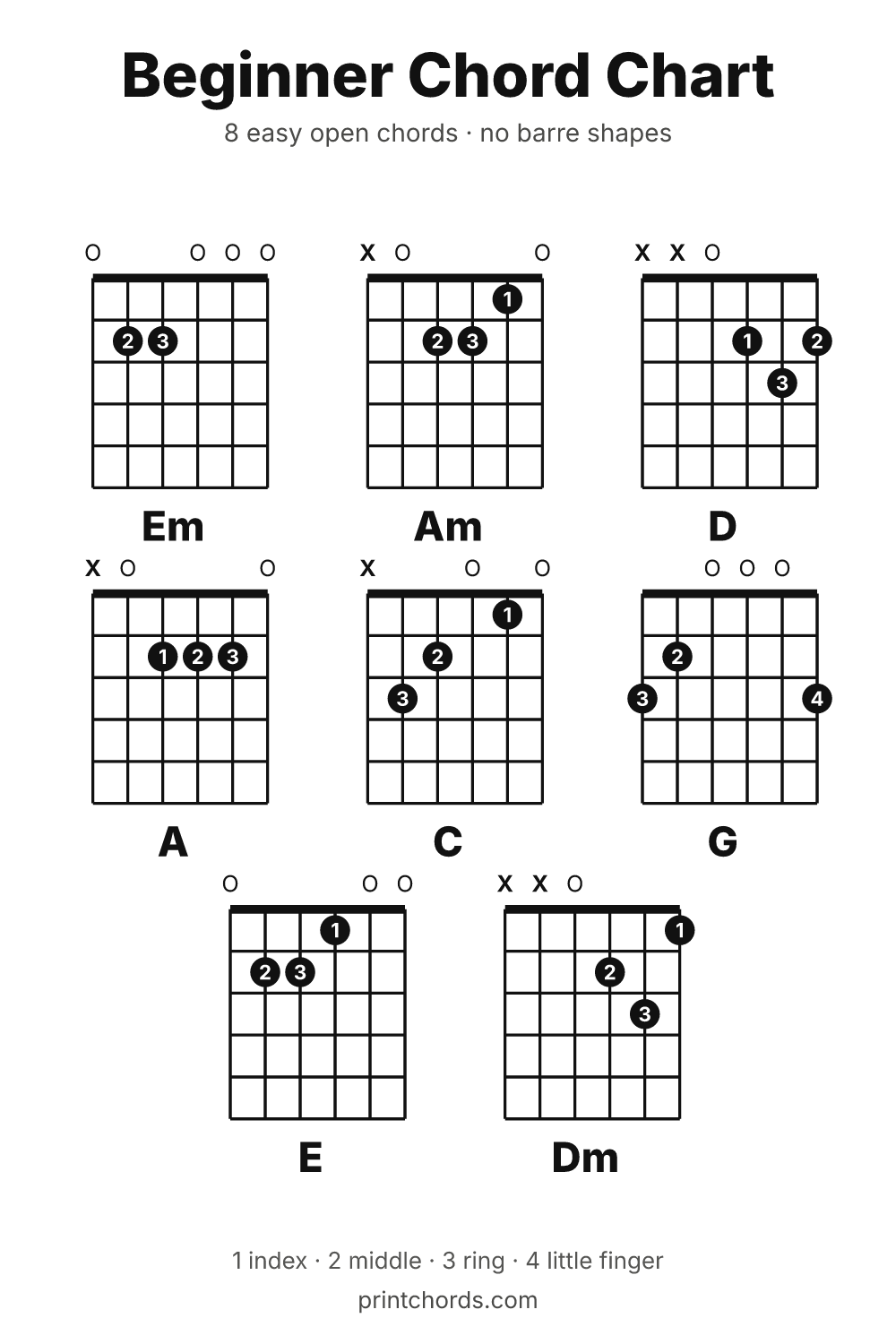
Eight easy open chords, in the order they are worth learning. No barre shapes.
Printable version
How to use this chart
Every chord here is an open shape: at least one string rings without being pressed, and no finger has to hold down more than one string at a time. That is what makes them playable in a first week.
The order matters more than the list. Em and Am come first because they use two and three fingers in adjacent frets, and moving between them changes almost nothing. D and A follow, then C and G, which are the two shapes that take the longest to make clean. E and Dm round the set out.
Nothing on this sheet is a barre chord. When these eight feel automatic, the full chord chart adds F, Bm, B7 and D7, and that is the right moment for them, not before.
Teaching from this chart? Everything here is free to copy for a class, and the page for teachers covers what to print, what you are allowed to do with it and how to link to it.
1 Two chords at a timePick a pair and move between them for a minute without stopping. Two clean chords beat eight rough ones.
2 Check every stringPlay the chord one string at a time. A buzz usually means a finger is flat rather than arched.
3 Add the strumming hand lastOnce the shape lands reliably, keep a steady strum going and let the chords change on the beat.
Chords with more than one shape
Most chords on this sheet have one grip worth knowing. These have several, and the choice changes how easy the next chord is. Each of them has its own page.
Other printable sheets
Guitar Chord Chart 12 essential guitar chords. Print the full chart or save it for later. View chart → Power Chords Chart Eight power chords, and the two movable shapes that give you all the rest. View chart → Blank Chord Chart Empty diagrams to fill in by hand, 6, 12 or 24 to a page. View sheet → Printable Chord Chart Every sheet on the site as a PDF, ready for A4 or US Letter. View sheet → Pentatonic Scale Chart The five box shapes in any key, with the frets you actually play. View sheet → Guitar Scales Chart Five scales across the whole neck, roots marked, in any key. View sheet →
Frequently asked questions
What is the easiest guitar chord to start with?
E minor. It uses two fingers in the same fret on neighbouring strings and all six strings ring, so there is nothing to mute and very little to get wrong.
How long does it take to learn these eight chords?
Most people can play all eight recognisably within a few weeks of short daily practice. Changing between them cleanly at song speed takes longer, and that is the part worth spending the time on.
Why are there no barre chords here?
Barre chords need hand strength that builds up from playing open chords first. Starting with F or Bm usually produces a muted, buzzing sound and a lot of discouragement. They are on the full guitar chord chart for when you are ready.
Do I strum all six strings on every chord?
No. Each diagram marks the strings that stay out of the chord with an X above the nut. A, C and Dm all leave at least one low string out. Aim the strum at the first string without an X.