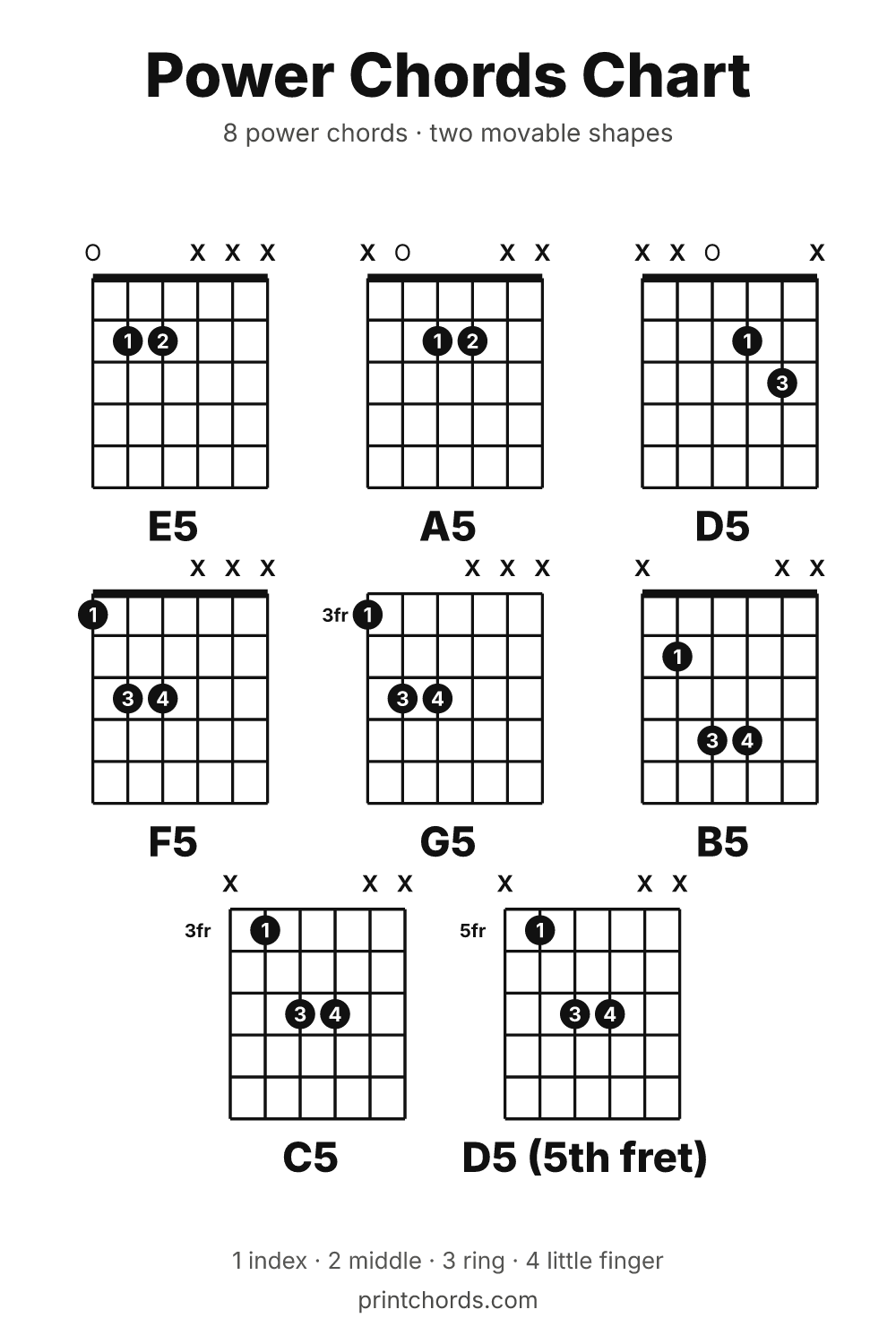
E5
Power Chords Chart
Eight power chords, plus the two movable shapes that cover every other one.
A5
D5
F5
G5
B5
C5
D5 (5th fret)
Printable version
How to use this chart
A power chord is two notes: the root and the fifth. Often you double the root an octave up. There's no third in it, so it's neither major nor minor, and under distortion that's what keeps it clear while a full chord turns to mud.
You only need two shapes. One has its root on the sixth string, the other on the fifth, and you can slide either one anywhere on the neck. F5 at the first fret gets you every chord rooted on the low E string. B5 at the second gets you the rest. The open E5, A5 and D5 work the same way, just with an open string doing the job.
Muting is what makes or breaks a power chord. Let the strings you aren't playing ring and the chord falls apart. Rest the side of your strumming hand lightly on the bridge, and keep the unused strings damped with the fretting hand.
Teaching from this chart? Everything here is free to copy for a class, and the page for teachers covers what to print, what you are allowed to do with it and how to link to it.
1 Two fingers firstIndex finger on the root. Ring finger two frets up, on the next string. That's the shape.
2 Add the octavePut your little finger one string higher to double the root. The chord gets thicker, not different.
3 Move itSlide the shape up or down and read the root off the fret. Two shapes cover the whole neck.
Other printable sheets
Guitar Chord Chart A guitar chord chart with the 12 essential chords. Print the whole thing or save it for later. View chart → Beginner Chord Chart Eight easy open chords, listed in the order you should learn them. No barre shapes anywhere. View chart → Blank Chord Chart Empty diagrams to fill in by hand, 6, 12 or 24 to a page. View sheet → Printable Chord Chart Every sheet on the site as a PDF, ready for A4 or US Letter. View sheet → Pentatonic Scale Chart The five box shapes in any key, with the frets you actually play. View sheet → Guitar Scales Chart Five scales across the whole neck, roots marked, in any key. View sheet →
Frequently asked questions
What is a power chord on guitar?
It's two notes: the root and the fifth above it, and often the root doubled an octave higher. There's no third, so the chord is neither major nor minor. That's what lets the same shape sit over both.
Why is a power chord written with a 5?
The 5 means the chord holds the root and the fifth and nothing else. E5 is E and B. A5 is A and E. You're naming the notes, not a chord quality.
How many power chord shapes do I need to learn?
Two. One is rooted on the sixth string, the other on the fifth. Since you can move both, they cover every power chord on the neck. The open shapes are just handy, not something extra to learn.
Should I strum all the strings on a power chord?
No. Only the two or three strings in the shape should sound, and getting that right takes practice. Damp the rest with the side of your fretting hand and keep the strum tight.