Most common
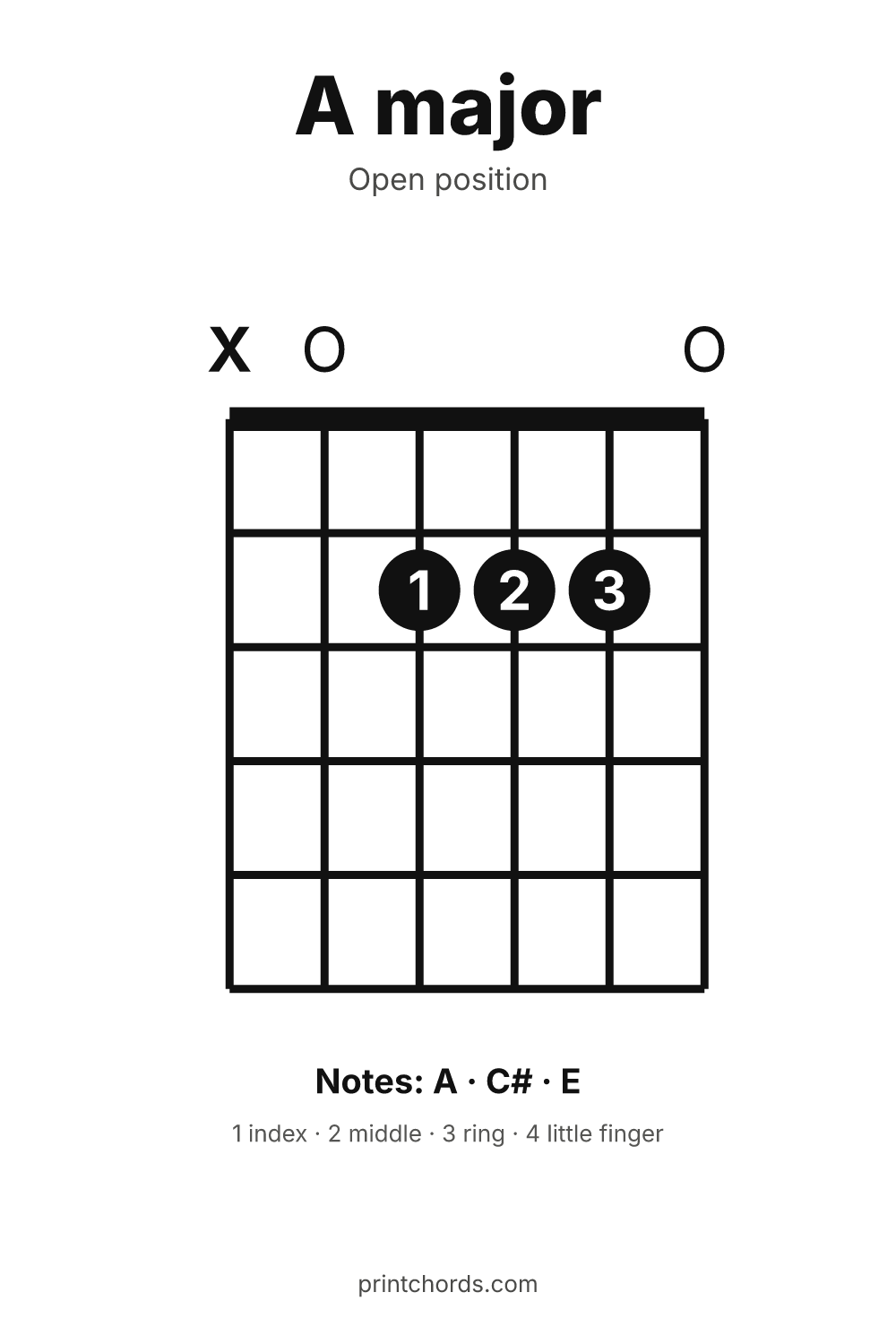
Open position
Three fingers in one fret. Keep them arched so the open high E rings clearly underneath.
NotesA · C# · E
Fret spanFret 2
DifficultyEasy
Best forAll players
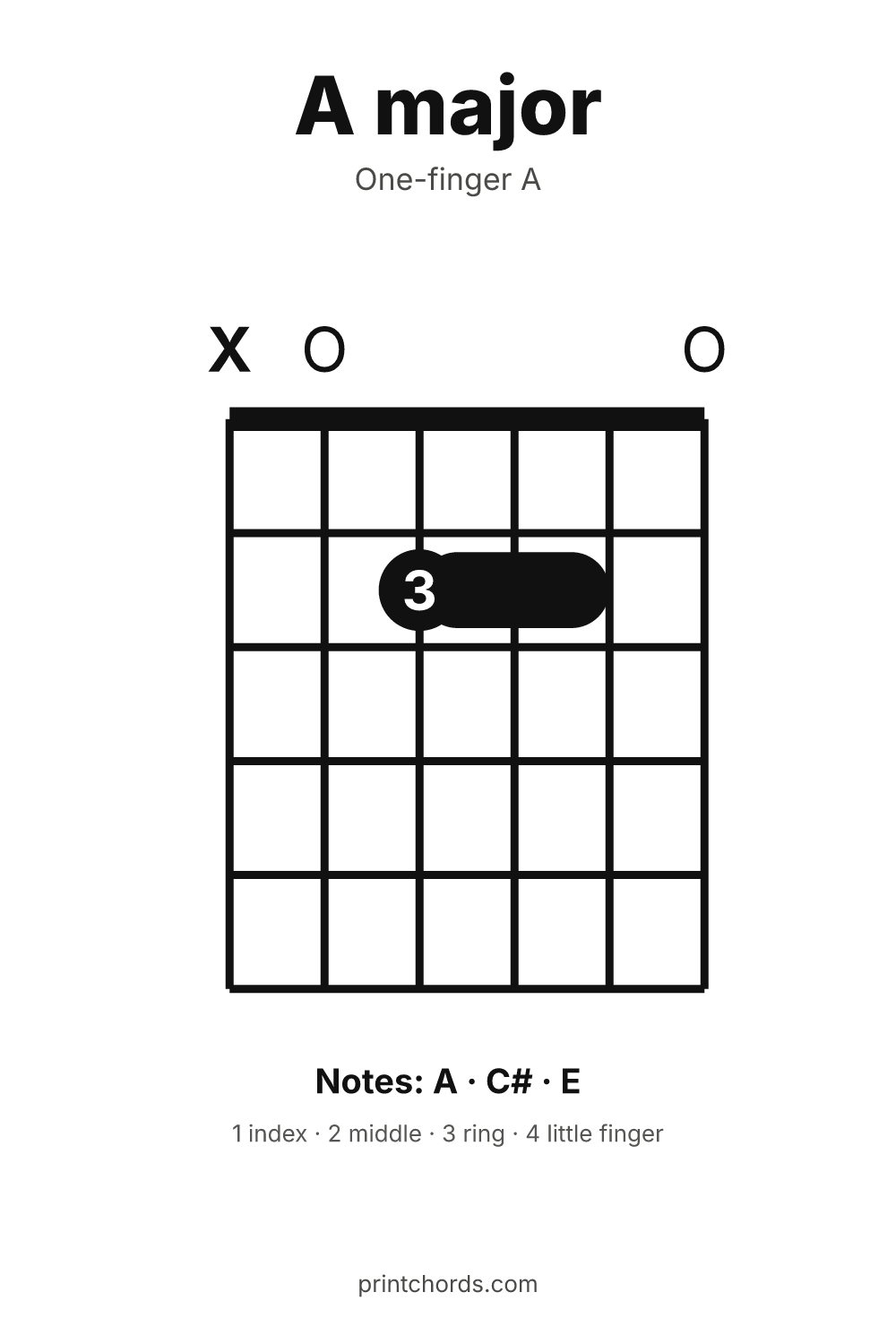
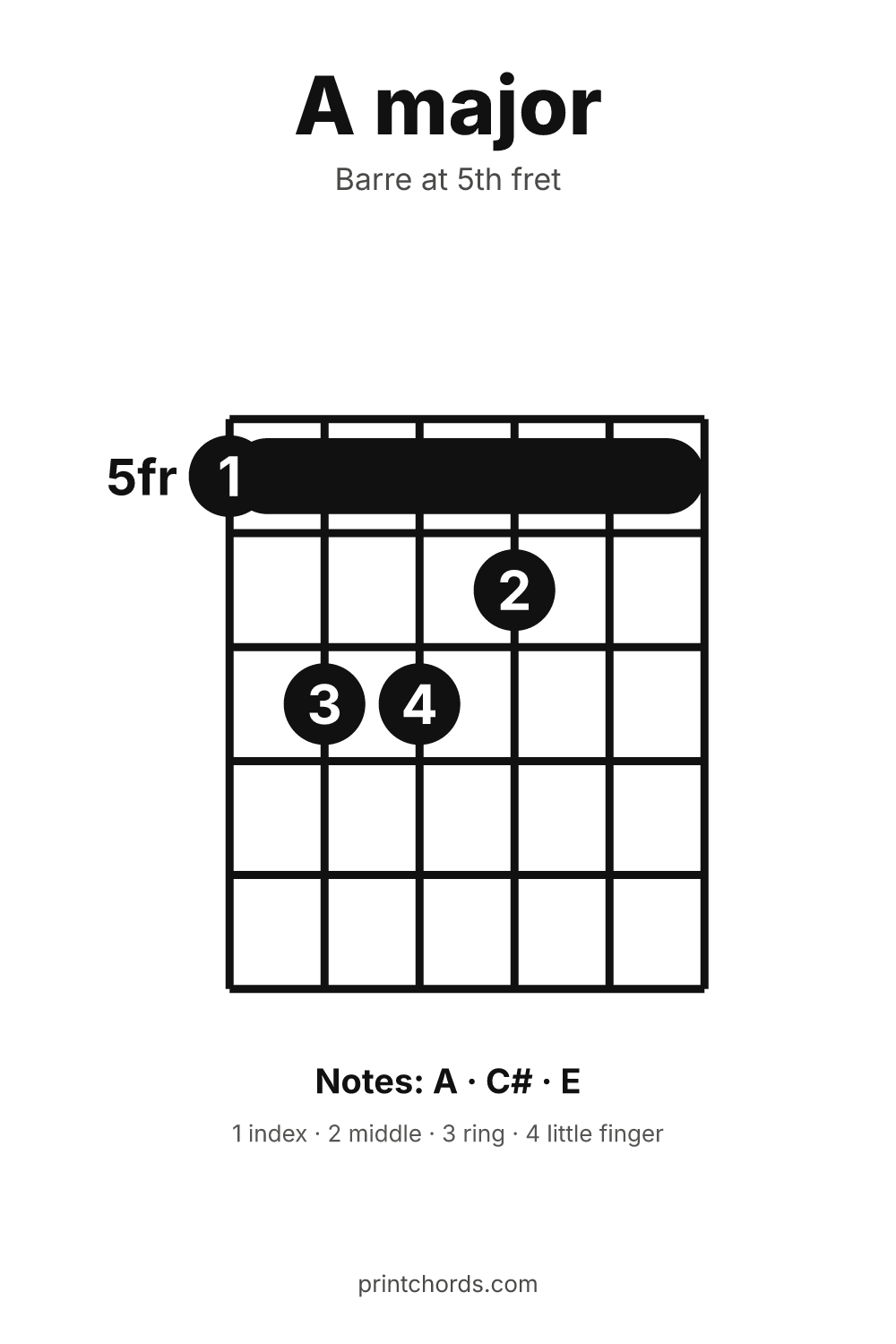
Three ways to play A major: the open shape with three fingers side by side, a one-finger version for small hands, and the movable E-shape barre at the fifth fret.
Most common
Three fingers in one fret. Keep them arched so the open high E rings clearly underneath.
For small hands
Flatten the ring finger across three strings. Same notes, far less crowding, and the open high E still rings.
Movable shape
The E shape moved up five frets. It is the same grip as the third-fret G, so one of them teaches you the other.
Every card below is the printable file itself, at full size on the page. Choose the shape that fits your hand and the chord that comes next, then print or download it on its own.
A is the root, C# is the major third, and E is the perfect fifth. Every shape on this page sounds those notes and nothing else; only the order and the octave change.
A belongs to all four of these keys, which is why it turns up so often in songs that never mention it in the title.
A major puts three fingers in one fret on three neighbouring strings, and that is the whole difficulty. Small hands run out of room, which is why the one-finger version exists: flatten the ring finger across the D, G and B strings and let the high E ring underneath it. It sounds the same and it is a legitimate grip, not a shortcut. The barre at the fifth fret is the same chord again in movable form, and it shares its shape with G at the third fret, so learning either one makes the other nearly free.
Practise the chord in context, then take the blank sheets to write down the shapes a teacher shows you.
The other chords with more than one shape worth knowing.
Open position. Three fingers in one fret. Keep them arched so the open high E rings clearly underneath. Once it lands cleanly every time, the other shapes on this page are worth adding, because each one buys you something different.
They contain the same notes, A, C#, E, but they put your hand in different places. Which one is right depends on the chord you are moving to next and on how much of the neck the song uses, not on which one is "correct".
Yes, because it moves. The E shape moved up five frets. It is the same grip as the third-fret G, so one of them teaches you the other. The grip costs more up front and then keeps paying for itself in every key.
Leave the low E string out and start the strum from the A string. The X above the nut marks every string that stays silent.
Yes. Each shape has its own Print button and its own printable card, so you can put a single fingering on the wall instead of the whole page. The PNG download is the same image at 1000 × 1500, sized for a phone or a Pinterest board.