Blank Chord Chart, 12 per page
Practice notes and lesson handouts
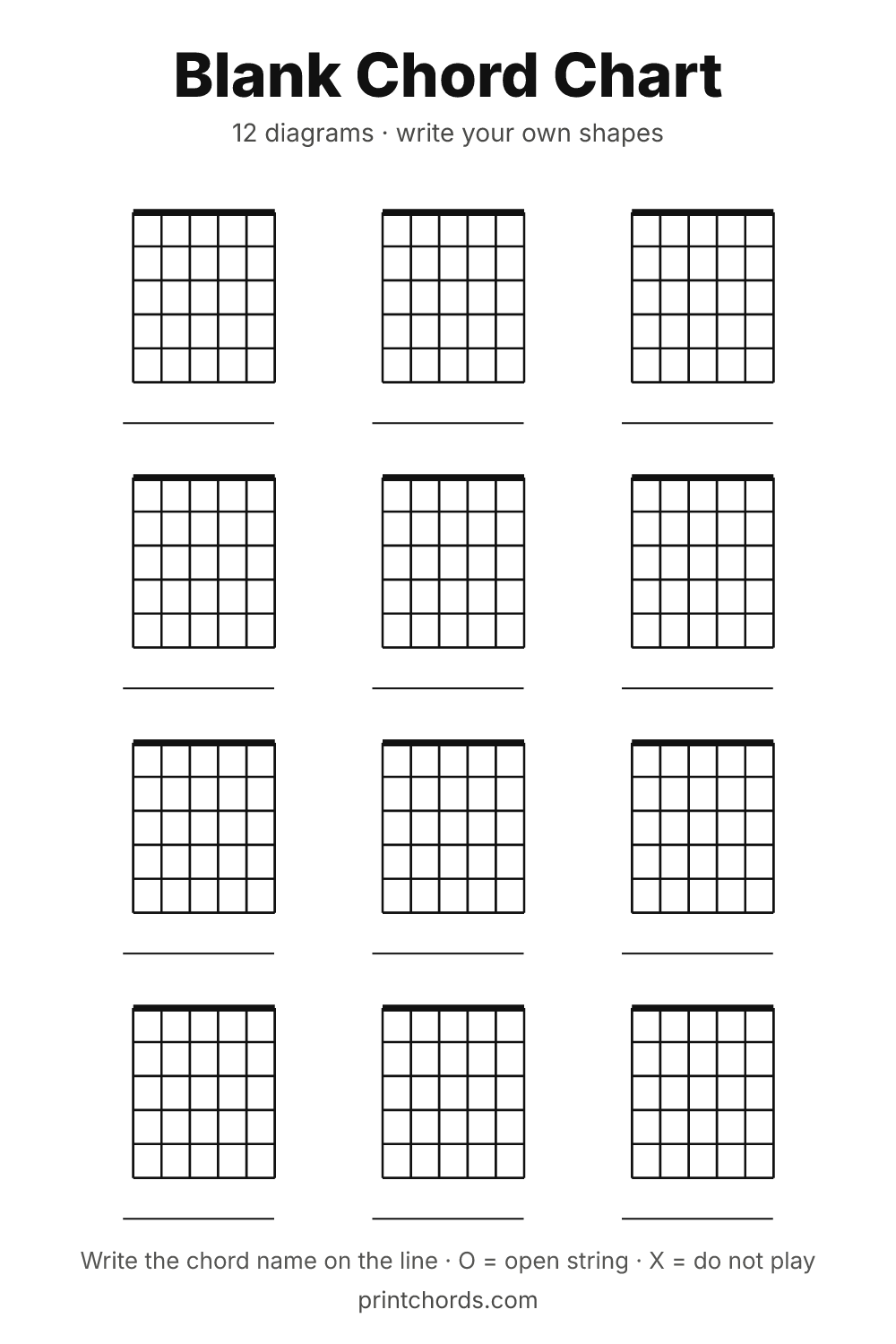
The everyday size. Room to write the chord name under each grid without crowding the page.
Empty chord diagrams to fill in by hand. Three sizes, all free to print.
Practice notes and lesson handouts
The everyday size. Room to write the chord name under each grid without crowding the page.
Songs and long chord runs
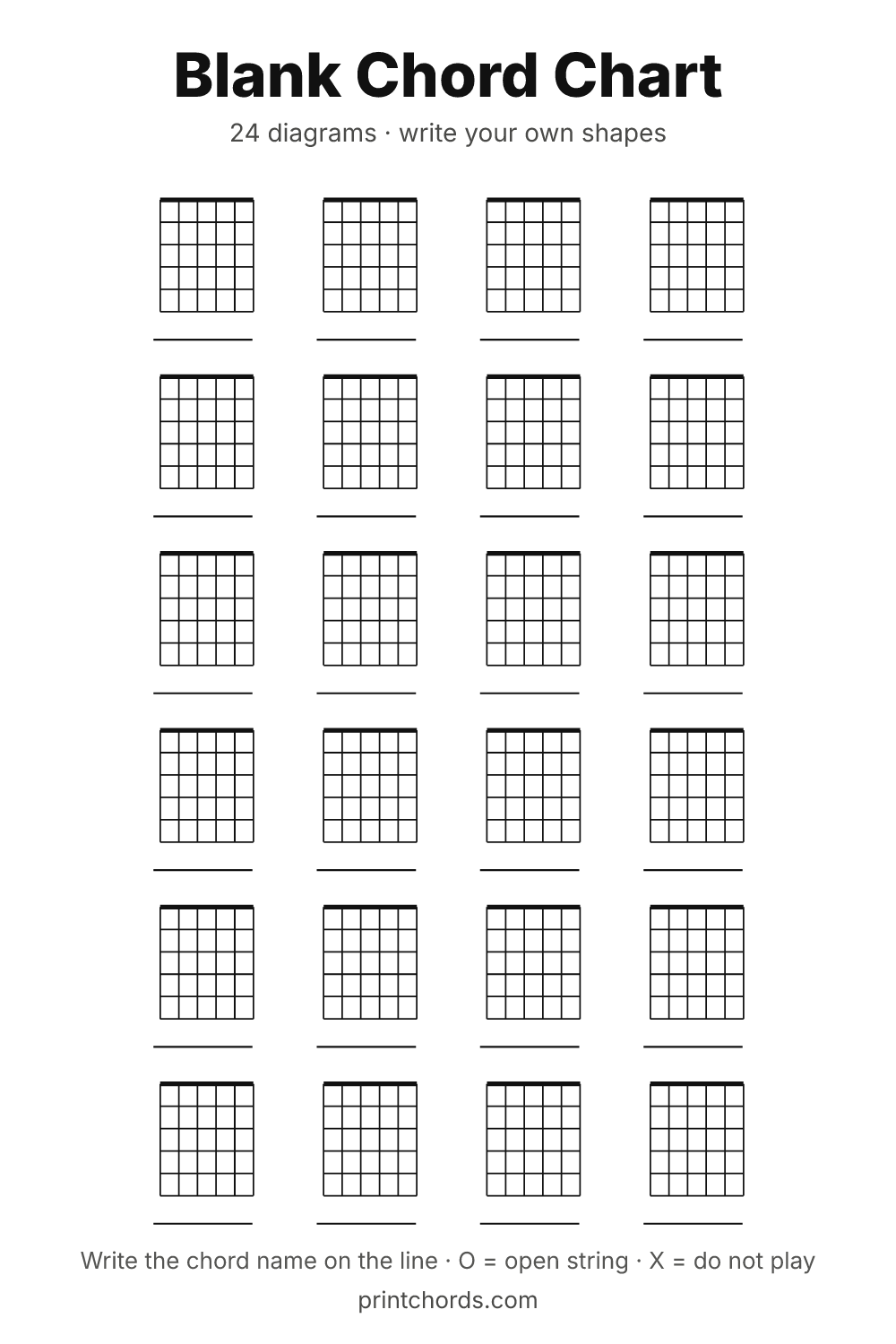
Twice the grids on one page, for a whole song or a set of variations without turning over.
Beginners and classroom walls
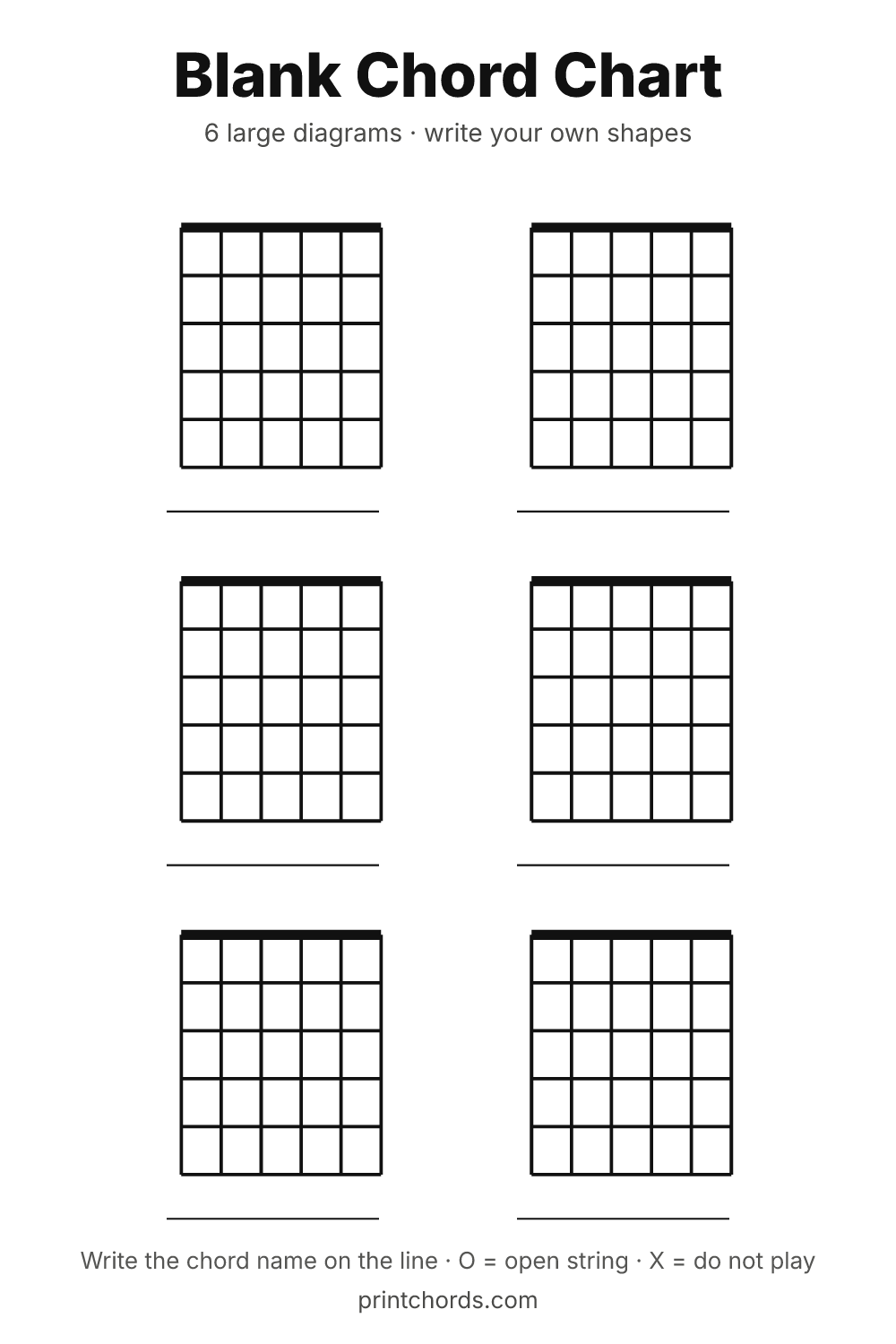
Big grids for young students, thick pens and anything that goes on a wall.
A blank chord chart is for the shapes that are not in any book: the voicing a teacher shows you in a lesson, the grip you worked out for one awkward bar, the four chords a student needs by next week. Writing a shape down by hand also fixes it in memory in a way that reading one does not.
Fill them in the same way the diagrams on this site are drawn. The six vertical lines are the strings, low E on the left. The thick line at the top is the nut. Put a dot where a finger presses, write 1 to 4 in it for index, middle, ring and little finger, and mark the strings above the nut: O for an open string, X for one you leave out. If the shape sits further up the neck, write the fret number beside the top row.
Choose the density by what you are doing. Twelve to a page suits practice notes, twenty-four fits a whole song, and the six large grids are the ones to hand a child or pin on a classroom wall.
Teaching from blank sheets? Everything here is free to copy for a class, and the page for teachers covers what to print, what you are allowed to do with it and how to link to it.
Draw a dot on the string and fret where each finger goes, and write the finger number inside it: 1 index, 2 middle, 3 ring, 4 little finger. Above the nut, write O over any string you play open and X over any string you do not play. Write the chord name on the line underneath.
Twelve diagrams to a page is the everyday choice. Take twenty-four when you are writing out a whole song and want it on one sheet, and the six large grids when the reader is a beginner, a child, or the page is going on a wall.
Yes. They are free, there is no sign-up and no limit on how many you print. The only thing on the page besides the grids is printchords.com in small type at the bottom, so a student can find their way back to the filled-in versions.
Both. The grids are laid out with enough margin that neither paper size crops anything, and everything is pure black and white, so a cheap printer with a tired cartridge still gives you usable diagrams.